Wednesday, 24 March 2010

The Beginning Of The Producing Of Our Film...


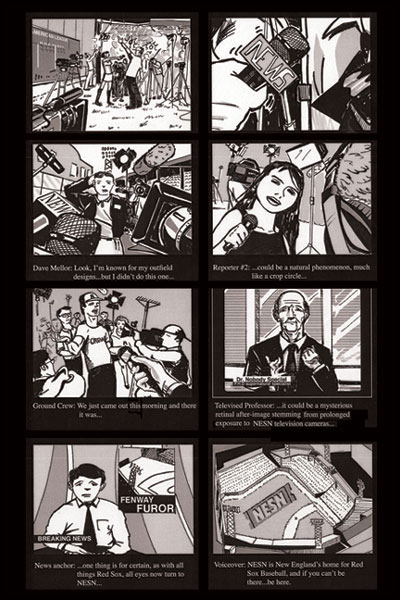
After we had decided the final storyline to use we had to then draft out and plan what and how was going to be seen on camera. We did this via storyboarding and planning. On the storyboard templates we were given there were also several lines and titles such as "Location","Action","Shot/Movement","Sound","Lighting","Editing Transition" and "Timing". These titles helped us to plan out exactly what would happen throughout the sequence so there wasn't any confusion on the day of filming.

First Production Group Meeting...

In our first group production meeting all members of our group had different ideas as to what they wanted to do and there was a alot to consider. To find out which one was really the best we decided the most efficient way to choose was to get each of our group memebers to write down the storyline of our individual sequence. So we all went away to decide which would be the best sequence to choose. Whilst considering which would be the best to do we also had to consider accessibility, storyline and actors we might use to play each specific part and whether we could find them within the school or whether we would need an external actor to come in and play the role.

Wednesday, 27 January 2010

Account of shooting day...

On Wednesday 20th January we shot our thriller sequence,there was a lot of previous planning involved. We had to write out a very detailed shooting script showing each bit of dialogue (if there was any), directions for the actors for their costumes and actions. We also had to draw out each shot in our storyboard and write out what special effects we would like to add them in post-production, the directions for actors and where abouts the camera would be located in each shot. We also had to draw out what we would like our set to look like and what we want in the frame.

Our firt location was a bedroom in Hurtwood belonging to 3 students in AS year. We did not have to do too much to the room as we wanted it to look natural and not set up this was all part of the mise en scene. In the end I think this location worked very well because it was quite a big bedroom which meant we had a lot of choice of where to set up the tripod as it was a big room. We also filmed in the corridor which was a little bit more challenging as the corridor was fairly narrow and we had to lay the track down with as little kinks or curves as possible.

We tried to use as many shots as we could to make it seem as interesting as possible, although for a lot of the time a tracking shot worked best. These tracking shots worked best becuase it meant that the girl walking could be followed, which created a really eerie feel. Another issue on our shooting day was the fact that it was snowing, this meant we couldnt use a tracking shot outside as the track would get wet and slippery and it wouldnt work as well. This was a bit annoying but we worked our way around it by using the tripod at very high and very low angles to make the shot interesting and to bring something new to the sequence. My favourite shot was a tracking shot we did past the reception with the girl walking down the stairs, I think this worked really well as it really reinforced the storyline.


The costuming for the shoot was fairly basic. We had decided that in order to portray a very ghostly look that our main character (the ghost girl) would just be dressed in a white floaty dress we agreed this costume would be best for her to portrat her ghostly-ness, she also had her hair backbrushed to make her look ghost like. Our other characters (the girl in the bedroom) was dressed in normal clothes although she was dressed in all black this was challenging the stereotype of good person white clothing, bad person black clothing. We did this because we wanted her to look as natural as possible, and we figured this was the best way to do it. The second person (man at reception) we had asked to also dress as if he was going to work, the reasons for doing this were the same as the previous character, we wanted him to look as natural as possible.

Casting was my main area in our shooting process, we had 3 characters to cast. For the main character (the ghost girl) I had originally wanted a blonde girl, who was quite skinny and very pale. Although I then chose a girl who had strawberry blonde hair who was very skinny and very pale.

Monday, 7 December 2009

Our Thriller film...

For out final thriller film our group had to choose one of our member's ideas to carry through and film as our final project. Our group consisted of Me, Nurit Hirschfeld and Katrina Kirby; Only having three people in our group did make it difficult when it came to the delegation of jobs. There were four jobs, Producer, Director, Cinematographer and Sound engineer. I was allocated the role of the Producer which meant I was in charge of getting hold of what the director had decidede she wanted, and although we did have set jobs we did alternate a fair bit between each job.

Thursday, 19 November 2009

Storyboarding...


Storyboarding is the practice of drawing out each shot in a movie and drawing what you want in the shot, this idea comes in especially useful when filming big budget sequences. Storyboards can be very complex and intricate or then can be very simple and obvious, they can also come with notes and stage directions, all of these factors are decided by the storyboarder.

Storyboarding is an essential part of film making in big budget sequences, most or if not all big budget films will have been storyboarded out before during explosions, or chases etc. Storyboardng can help you understand the Director's intentions and what the director wants or doesnt want you to see or notice. This idea of storyboarding can also be done on a collection of computer packages referred to as Pre-Viz.

What is a horror film ?


Personal

The audiences own identification with the FEARS or TERRORS of the narrative…

· Fear of the other/monster of the darkness
· Fear of the body being ripped/mutilated
· Our own personal boundaries being stretched and transgressed
· Emergence of terror at any level being enjoyed from a safe, vicarious distance


Ideological

The implicit (hidden) or explicit (obvious) messages embedded within the narrative…

· Themes of punishment, rejection, and/or revulsion at subjects which deviate from “correct” thinking
· From simplistic or basic messages the virgin “good girl” surviving at the expense of her rebellious “slutty” friend. To the more nuanced or subtle fears of strangers/hitchhikers breaking our boundaries…

OR the condemnation of any deviant (i.e. non Christian) religions…

Our perception that the power of science can defeat the darkness at the expense of older beliefs in religion and superstition…

· In our modern understanding of fear we rationalise the supernatural and defeat it with psychology rather than Latin chants.
· Modern media creates “demons” by crusading against sections of society and labelling them.
· Are there really so many more paedophiles in today than in the past? Not necessarily we just hear about more about them as they are more documented now,
· How many escaped mental patients have actually stalked and killed innocent people? Probably not very many but the media has built this up to be a daily occurrence.


Industrial/Financial

· Perhaps the most lucrative genre in the film industry, Horror draws in huge audiences justifying the control re-invention, re-making and franchising of very successful Horror product.
· We wonder whether there should be an “Indiana Jones 4” or a “Lethal Weapon” 5 but no questions raised over the legitimacy of producing Saw 6 or remaking “A Nightmare On Elm St.” after 9 previous incarnations.


We also had to give presentations to the class stating why our thriller film idea should be filmed. We had to include a USP (Unique Selling Point), a treatment,a character list.

Friday, 6 November 2009

Today we had an introduction to the basic video camera functions. We learnt how to focus, zoom, set up the camera, set up the tripod, install the battery, and install the sound recorder.

To install the battery you need to get the battery and slide it into the battery compartment until it clicks.

To focus the image in the camera you need to adjust the ring on the end of the camera, the focusing ring is next to the zoom ring. You need to turn the ring either clockwise or anticlockwise until the image through the viewfinder/screen is clear precise and in focus.

To install the sound recorder you need to connect the wire to the AV1 socket and screw it in to the holder.

To zoom the camera in or out there are two ways this can be done. There is either the zoom button which is directly in front of your hand if you’re holding the camera. There is also the zoom ring on the end of the camera, next to the focus ring.

Setting up the tripod correctly is a fundamental part of filming. To set up the tripod correctly you must "bubble" it. "Bubbling" the tripod means to get the bubble on the top of the tripod in the center of the ring. The bubble is in a spirit level on the top of the tripod and the ring in printed on the top of the Perspex covering. You must also make sure you connect the "pan handle" correctly, this is basically a handle to the left of the tripod, and this handle enables you to pain the tripod left or right. Then you must attach the camera to the tripod, you need to slide the camera on to the tripod and it will click, this is how you know the camera is attached correctly.